If the beginning of my Bremen story started with lost luggage and confusion, the ending feels more like… legacy. Not the kind with golden statues or streets named after you (yet), but the kind where people say “thank you” and mean it. The kind where your work starts living its own life, even after you’ve left.
In these final months, something quietly shifted. I had to say goodbye to some of my flatmates—people who, over time, became my accidental family. The apartment got quieter, emptier. But life has its own way of balancing things out: you say goodbye to some, and hello to others. I had my second seminar, met incredible people from all over the world, and somehow ended up with even more friendships than I started with. That’s the beautiful contradiction of this experience—life constantly takes and gives.
And then, the sun came out. Literally. After months of grey skies and being told, “Just wait for summer, you’ll see,” I finally saw. Bremen transformed into a festival city: music fests, exhibitions, street fairs. Breminale, sunshine, people everywhere—it was like watching the city bloom. And so did my projects.
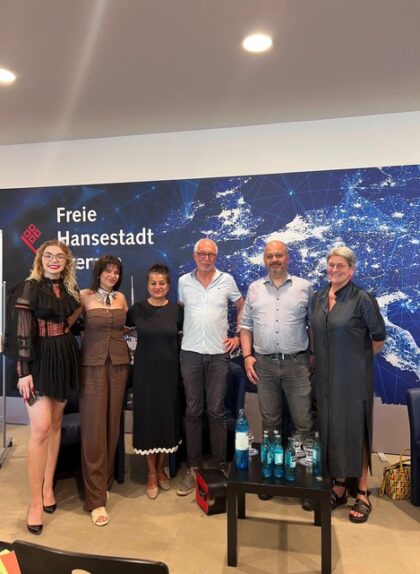
Originally, I had big plans for the European Week—working on national minorities’ issues—but, as it often happens in life (and Germany), plans changed. I couldn’t take part officially, but I didn’t give up. Instead, I did what political science trained me for: adapt, network, and rebrand. I connected with passionate people, raised funds, and transformed the concept into something that mattered deeply to me—a «Panel discussion on dual citizenship», especially focusing on how minorities face bullying, bureaucracy, and inequality because of it.
We welcomed 40 guests, hosted speakers from different fields, and the Vice President opened the event. I felt a strange, quiet pride watching people thank me afterwards, take photos with me, and say they finally understood the topic better. My co-organizers told me this was a much-needed step and they’re already planning to do something similar next year. It hit me then—I may be leaving soon, but the trace I’m leaving behind will stay. I’m not just building a CV—I’m building something that matters.
That’s also how I feel about my guided tours. I recently counted—and turns out I’ve led around 300 people through the halls of democracy in Ukrainian and English. 300 people got a little closer to understanding how political life in Bremen works, and my proudest moments were always the ones with Ukrainians. It’s crucial for them to hear their own language echo in a place like this—to feel seen, not forgotten. And every time I doubted whether I belonged here or whether my work mattered, I remembered the smiles, the questions, the curiosity after those tours. And I knew—I do belong.
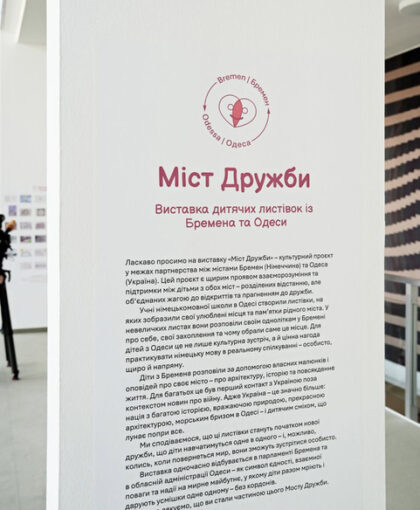
Remember the kids’ postcard project I mentioned in the first report? We made it happen!
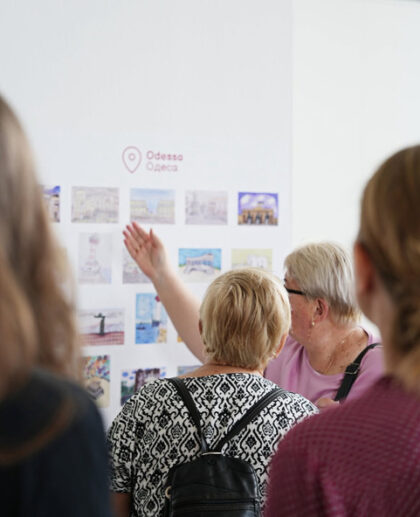
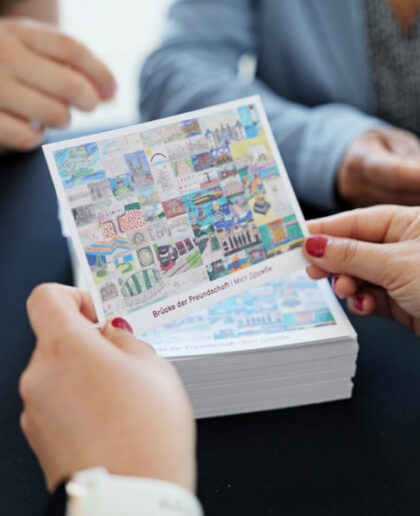
In total, 60 children from both cities took part. Each of them drew their favorite landmarks—colorful sketches of buildings, squares, seaside views, cathedrals—and wrote personal messages to a child across the border, introducing themselves and sharing a piece of their city and life. But we didn’t stop there. Both schools also created short videos, where the kids showed what their school lessons look like, how their classrooms feel, and even shared their own personal stories. Watching them speak into the camera with curiosity and courage was deeply moving.
I personally visited the school in Bremen and talked to the kids there. They were so engaged and full of questions—not only about the project, but about political life in general. “Why do we need a parliament?” “Who makes the rules?” “Can kids change something too?” That moment reminded me that political education doesn’t start in university. It starts with questions like these—and projects like ours.
On the other side, for the Ukrainian kids, the impact was perhaps even deeper. In the middle of air raid sirens and bomb shelters, this project was a way to feel normal again. A way to connect with someone far away, to practice their German, and to feel—if only for a moment—seen and heard. Many of them wrote about how excited they were to have a friend abroad, to show their drawings, and to imagine visiting Germany one day. And who knows—maybe one of them really will.
But it wasn’t only emotional. This project had a real political dimension, too. First, by drawing their local landmarks, these kids might have unknowingly sparked future tourism—maybe someone sees a postcard, and thinks, “Hey, I want to visit that place.” Second, it served as a concrete step in reviving the sister-city relationship between Bremen and Odesa. And finally, it showed that even the youngest voices can carry meaning across borders.
We named the project Bridging Friendship—because that’s what it does. It builds a bridge. Between cities. Between languages. Between realities. Between kids who might one day meet, travel, or even change the world—together.
And I hope, truly, that this project doesn’t stop here. That next year, it grows bigger. Or that its soul lives on in some new form. Because if there’s anything I’ve learned, it’s that even a small act of connection—like a crayon drawing and a handwritten note—can leave a mark on someone’s life.
And because I love challenges, I also created a 3-4 hour interactive lesson about Ukraine for teenagers in around 10 schools in Bremen. Not about war or trauma, but about history, culture, language, identity. I wanted to give them a different picture of Ukraine—and I hope the next volunteer picks up this thread and keeps it alive.
Somewhere along the way, I stopped feeling like a guest. I started running in the mornings. I found “my” bakery. I learned which tram to take without checking Google Maps. I even give directions now (!). I might still have an accent, but I think I can officially call myself a «Bremenian».
To sum it up: being the first is always hard. No footsteps to follow, no templates, no “here’s what you’re supposed to do.” Just a jungle of expectations, blank pages, and occasional doubts from others—and yourself. But you can either give up… or, as we say in Ukrainian, go Through thorns to the stars, and make that path not only walkable, but desirable—for future volunteers, and for the place itself.
And if you ask me why I studied political science, did so many internships and crazy projects—this is the answer. Because I always wanted to do exactly this. Help people. Create change. Leave a mark.
And I think—I did.
Now, after all this time, I’ve started to realize that maybe I didn’t do everything I wanted to. Maybe I could’ve traveled more, launched more projects, laughed more often.
But everything happened the way it was meant to. And hey—maybe that’s just a reason to come back one day and finish what I started.
Bye, Bremen.
And maybe… see you later.
(After all, I touched the legs of the Town Musicians—and legend says, that means you’re bound to return.)
Karyna was hosted by Bremische Bürgerschaft on our project co-funded by the European Union.
If you want to experience something similar to what Karyna did, check out our open calls here.