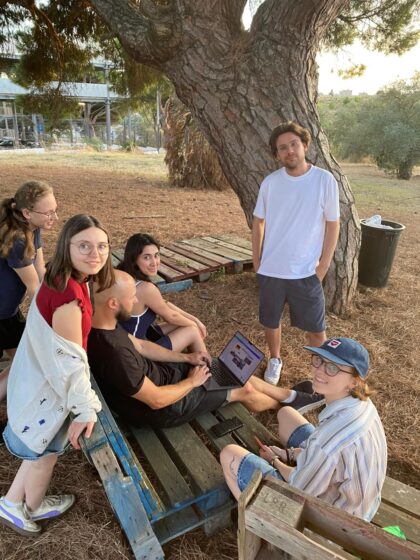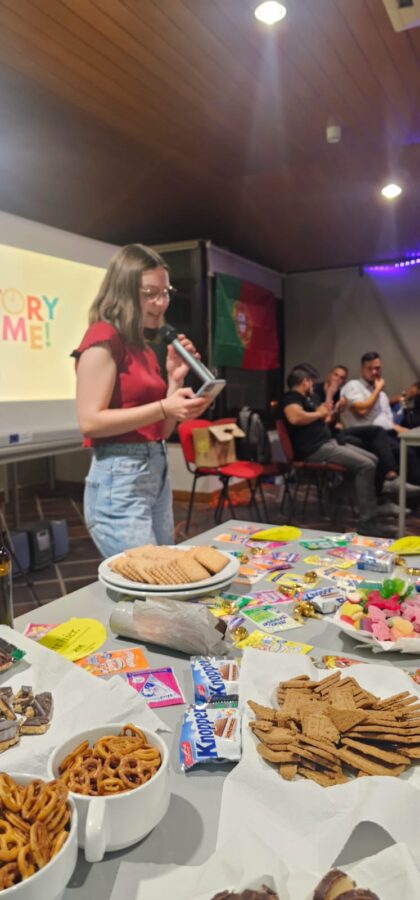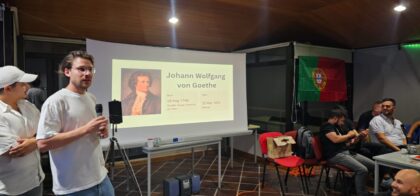

From September 10th, 2025, to September 17th, 2025, we participated in a one-week Erasmus+ youth exchange in Almada, Portugal. Together with a total of 36 young people from six different countries (Italy, Spain, Armenia, Cyprus, Portugal, and Germany), we met under the motto “Heads Up, Screens Down.”
As the title of the exchange project suggests, we engaged in various activities to explore the influence our smartphones have on us and to develop alternatives to digital media consumption.
After getting to know each other on the first day, we began to explore and work on the topic together.
A particular highlight was when elderly people from a Portuguese retirement home visited us for a day. With cookies and tea, we talked to them about their lives and the time before mobile phones. This was an enriching experience for both sides. We found it especially exciting that the intercultural exchange of the project also became an intergenerational exchange.
Another highlight of our stay was learning and practicing Qi Gong. Qi Gong is an East Asian practice similar to yoga, which focuses on mindfulness. With a wonderful teacher, we learned on Almada beach how to connect with our bodies through breathing techniques, self-massage, and stretching exercises, thereby bringing ourselves into harmony with the world.
We also developed our own board games in small groups of six. This allowed us not only to unleash our creativity but also to try out practical alternatives to mobile phone use.
Voices from the German team
Why did you participate?
Fereshteh: I learned a lot about dopamine addiction and how social media shortens our attention span. When I found this project, I thought: This is a perfect opportunity for me! Especially because the project took place in Lisbon, a city I had long wanted to visit.
Lea: I constantly rely on screens and the internet for my studies, so I thought it was a good idea to consciously disconnect for a while and gain new experiences with new people in the present moment.
Peggy: Nowadays, almost nothing works without screens. No matter what I do during the day, it usually involves a digital device. I noticed this especially in the free time between school and university. That’s why I wanted to use this time to engage more deeply with the topic. Therefore, I applied for the project.
What did you learn? What was new or surprising?
Fereshteh: We learned a lot about Portuguese culture and history and realized how important offline activities are. For example, we got to know board games and group games without cell phones. At the cultural evening, all countries presented something. I was particularly surprised by Armenia: I learned that there are many Persian words in the Armenian language (Persian is my mother tongue). I also didn’t know that Armenia was the first country to adopt Christianity as its official religion.
Lea: I learned that no matter how many Erasmus+ projects you’ve already done, it is always worthwhile to be open and engage with new people and nationalities. Of course, the internet and mobile phones help to stay in touch, but spending time together offline in real life remains the most valuable experience.
Peggy: In the project, I learned how important it is to connect with real people. I also realized that it is absolutely okay to use digital devices – you just need to be aware of your consumption. In many everyday situations, we turn to technology without it actually being necessary.
In addition, I learned a lot about the different cultures and languages of the participating countries, especially about Portugal. I found Armenia particularly interesting, especially the fact that people there often use Russian to translate words or even to watch movies in cinemas, since Armenian is not offered in translators.
What are you doing differently at home now?
Fereshteh: I will think more consciously about my online and offline habits. Now I have a better idea of how to balance the two. We also explored Lisbon during the project. Thanks to the city tours, I now know how to learn about a city before traveling there so I can enjoy it more.
Peggy: The internet is an indispensable part of my everyday life, but after the project, I now think much more consciously about my internet use and try to deliberately integrate offline activities into my daily routine.
Further thoughts:
Lukas: To me, the coming together of different Europeans and the intercultural aspect of the project seem much more important than the topic and specific content. I believe that such encounters not only create cross-border friendships but also an awareness of the cultures of our neighboring countries. Such projects embody a living idea of Europe. They teach us what it means to be European and to work together as Europeans.
“Work or Workless” youth exchange is financed by the Erasmus+ Programme and organized by our partner organisation RUA.
If you want to experience something similar, check out our open calls here.